

Does recuperation happen only during driving downhill?
No. It also works when you lift your foot off the accelerator or brake gently, although downhill driving usually recovers the most energy.

After driving 50 km with a 60% battery charge, you could end up with 55% remaining. But here's the plot twist: after driving the same distance, you could also end up with just 48%. That 7% difference could be the reason you drive straight home or have to stop for a quick top-up on the way. The difference comes down to regenerative braking – the ability of electric vehicles to recover energy while driving.
How do you make most use of it and get as many free kilometres as you can? Find out here! Moreover, we will also show you a special feature in the go-e Charger for those using recuperation.
Key facts at a glance:
Jump to the topics that interest you the most
Regenerative braking (also known as recuperation) is the ability of an electric car to recover energy during deceleration. Unlike petrol or diesel cars, which simply waste this energy as heat every time you slow down, EVs turn part of it back into electricity. This electricity can be used for driving or to power onboard systems like air conditioning, heating, and infotainment.
Every bit of recovered energy helps you drive farther on the same battery charge. It can reduce the number of charging stops, lower running costs, and even extend the life of your brake pads since the car relies less on conventional friction brakes. In city traffic or on downhill roads, regenerative braking can recover a surprising amount of energy that would otherwise be lost.
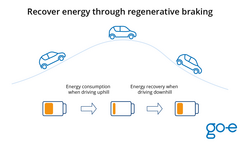
The recovery process activates whenever the vehicle needs to slow down. This typically happens in three scenarios:
Good to know
When you set deceleration to the highest or, with some EVs, even the second-highest level, you basically can drive with almost never using the brake pedal. This is what one-pedal driving is. However, not every electric car offers such an option.
While the vehicle slows down, electrical current is produced by the motor. It is immediately used for charging the main EV battery. The amount of energy the car can get back depends on several factors, including driving mode, speed, and more. But to give you a picture of what it could look like, here is a scenario where you begin a short commute with a fully charged 80 kWh battery.
Journey phase | Without regenerative braking | With regenerative braking |
|---|---|---|
Start of trip | 80.0 kWh | 80.0 kWh |
Energy used while driving | −20.0 kWh | −20.0 kWh |
Energy recovered during braking | 0.0 kWh | +4.0 kWh |
Battery at end of trip | 60.0 kWh | 64.0 kWh |
Good to know
Yes, but not always. It depends on how quickly the car is slowing down.
With one-pedal driving, simply lifting your foot off the accelerator is often enough to trigger the brake lights automatically.
The main benefits of recuperation are lower operating costs, longer range, and reduced brake wear. As a bonus, regenerative braking makes driving more sustainable because the less you use the friction brakes, the less brake dust is produced.
Full advantages overview:
Among the main drawbacks of recuperation is the need to adapt your driving style to get the most out of it. In addition, regenerative braking is less effective in some scenarios.
Full limitations and disadvantages overview:
When an electric car is decelerating, it produces a vast amount of kinetic energy. This is because the friction of the brake discs generates heat. The electric motor uses this braking energy to charge the vehicle’s battery.
In plug-in hybrids, just like in purely electric cars, recovered energy is stored in the battery. By the way, non-plug-in hybrids, which can't be charged externally (e.g. with a go-e Charger), get most of their energy from recuperation.
Coasting (freewheeling) means taking your foot off the accelerator and letting the car continue rolling freely with little or no braking force. Regenerative braking, in contrast, slows the car automatically when you lift off the accelerator while converting some of the vehicle's motion into electricity to recharge the battery.
| Coasting | Regenerative braking |
|---|---|---|
Energy action | Preserves kinetic energy as motion, allowing the vehicle to keep rolling. | Converts kinetic energy into electrical energy, which is stored in the battery. |
Best for | ||
Driving feel | Standard wear when you eventually use the physical brake pedal. | "One-pedal driving" feel; the car decelerates noticeably as soon as you lift your foot. |
Most modern electric cars let you adjust the strength of regenerative braking. You can change the setting using the display, steering-wheel paddles, or dedicated buttons. Pick a level based on your preferences and road conditions.
There is no universal system for recuperation levels. For instance, Cupra Born offers two modes: D (driving) and B (braking). In an electric BMW, on the other hand, you can customise these levels in gear position D via the iDrive menu (Low, Medium, High, or Adaptive) or enable maximum regeneration (one-pedal driving) by shifting to B. Here’s an example of how you can use the BMW recuperation levels:
Regeneration level | How it feels | Best used for |
|---|---|---|
Low | The car is coasting freely. Very little resistance when you lift off the accelerator. | Highway driving. It’s more efficient to let the car glide at high speeds than to constantly slow down and speed up. |
Medium | It feels like mild engine braking in a manual transmission car. A gentle, natural slowdown. | Everyday driving if you prefer a traditional car feel but still want to claw back some energy. |
High | Strong deceleration. The moment you lift your foot, the car noticeably brakes itself. | Stop-and-go traffic or hilly roads where you want to harvest maximum energy. |
Adaptive | The car uses GPS data, speed limits, and radar/cameras to decide how much to brake. | The "set-it-and-forget-it" option. Excellent for drivers who want the car to think for them. |
Modern electric cars recover around 22% of the energy they use on average under typical driving conditions. Nevertheless, the exact amount depends on the vehicle, driving style, terrain, traffic and many other factors.
Example of recuperation efficiency:
Driving conditions | Average energy recovered |
|---|---|
Downhill driving | ≈40% |
City driving | ≈33% |
Country roads | ≈21% |
Highway driving | ≈12% |
Source: ADAC
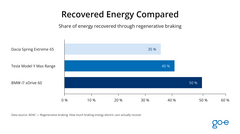
The amount of energy that can be recovered also depends on the vehicle. To compare different EVs fairly, ADAC tested them on the same simulated 5.5 km downhill route with gradients of up to 10%. Here’s how efficiently three different car models recuperate in the same conditions:
What does this mean in practice? A Tesla Model Y Long Range (75 kWh battery, 16 kWh/100 km consumption) driving down a long mountain pass can recover around 2 kWh through regenerative braking. That's enough energy for approximately 12 km of additional driving range.


Ronald Kroke, Head of Marketing at go-eOver time, those recovered kilowatt-hours really add up
On my 42 km commute to work, I drive my Hyundai IONIQ 5 mainly downhill. Using the second-highest regenerative braking setting, I recover around 4 kWh of energy and use just 2 kWh from the battery. On the way home, climbing almost 900 metres in altitude, the numbers reverse: I get less than 2 kWh from braking but use 8 kWh from the battery. All in all, it saves a considerable amount of energy.
The main factors that affect the efficiency of recuperation are:
Let’s take a closer look at each of them!
1. Driving environment
Regenerative braking works very well in city traffic. Since you need to make frequent stops at traffic lights and intersections, there are a lot of braking opportunities. One-pedal driving is absolutely great for that. Driving on a highway is completely different, as you keep the same speed for longer periods and there is not much braking involved.
2. Road gradient
Tests as well as real-like drivers’ experiences show that downhill roads are the best for recovering energy through recuperation. Efficiency peaks because the regenerative braking system works harder at higher speeds. The longer and steeper the descent, the more energy you can typically get back.
3. Vehicle speed
The faster you're driving, the more kinetic energy your car has to recover. That might make highway driving seem ideal, but it usually isn't. Since you rarely brake on the highway, there are fewer chances for regenerative braking to recharge the battery.
4. Vehicle weight
Heavier EVs have more kinetic energy, so they can recover more of it when slowing down. For example, a Tesla Model X can regenerate more energy than a Model 3 at the same speed. But since heavier cars also use more energy to accelerate, the overall efficiency gain is usually small.
5. Motor and drivetrain
Not all EVs regenerate equally. When two similar EVs slow down from the same speed, the dual-motor version can usually send more energy back to the battery than the single-motor version because both motors help convert the car's momentum into electricity.
6. Driving style
This is one factor you can actually control. When you drive smoothly and look ahead, you’re more likely to benefit from recuperation. If, on the other hand, you treat every green light like the start of a Formula 1 race only to hit the brakes hard at the next red light, not much energy will be recuperated.
7. Regeneration level
Even though the variety of options in every electric car may differ, you can normally choose how strong regenerative braking should be. You must understand when to use each mode. Something many new EV drivers ignore is that maximum regeneration level isn't automatically the most efficient one.
Regenerative braking has its limits. It will be lower or might even not work at all when the battery is fully charged or before it has reached its optimal operating temperature on a cold day. The same goes for slippery roads, where strong regenerative braking could compromise traction and therefore safety.
While you can’t change weather conditions, the battery state of charge is under your control. We recommend avoiding starting with the battery at 100% if you're heading down a long hill. Besides missing out on free energy, you will have to rely on the brake pedal all the way down, which can feel surprisingly tiring if you're used to one-pedal driving.
ADAC analysed Green NCAP tests of 19 EVs under identical WLTP-like conditions (23°C, partially charged battery) to compare regenerative braking in everyday flat-terrain driving. Top recuperation rates were given to Nio ET7, Hyundai IONIQ 6, VW ID.5, Tesla Model S, XPeng G9 and BMW i4.
Car model | Recuperation percentage |
|---|---|
Nio ET7 100 kWh | 31% |
Hyundai IONIQ 6 77,4 kWh | 29% |
VW ID.5 | 26% |
Tesla Model S | 24% |
XPeng G9 Long Range | 24% |
BMW i4 eDrive35 | 24% |
To recover as much energy as possible, we recommend looking ahead while driving, selecting the mode that best suits your driving conditions, and avoiding the highest recuperation level when the road is slippery.
If you're trying to maximise your driving range (a technique often called hypermiling), look farther ahead and let the car coast whenever possible instead of accelerating and braking repeatedly. Just try to make it a habit. If, instead of slamming on the brakes a few metres before the red light, you lift your foot off the accelerator early, you will recuperate much more.
Your EV offers different driving modes for a reason. If you want to profit from recuperation, learn how to use these modes. In the city and on downhill stretches, activate one-pedal driving. If that’s not available in your car, simply switch to the highest recuperation level. On the highway, use coasting.
High regenerative braking forces can cause the driven wheels to lose grip and slide when the road is slippery. Luckily, many modern EVs adjust this automatically. Check if yours does. If not, reduce your recuperation level manually when driving on icy or highly wet roads.
When an EV battery is fully charged, regenerative braking is limited or even disabled because the battery has no room to store the recovered energy. The go-e Charger allows you to set a charging limit in kWh. This way, you have enough battery capacity for regenerative braking.
If you regularly drive downhill after leaving home, you'll recover more energy instead of wasting it. As a bonus, you'll also enjoy the smooth one-pedal driving experience instead of having to rely on the brake pedal all the way down.
Example:
Instead of charging the battery to ~56 - 58 kWh, set the charger to add 30 kWh. You'll start your trip with 55 kWh, leaving room to recover the remaining 5 kWh for free.
Regenerative braking may feel like a modern EV feature. In reality, it's been around for more than 100 years. Yes, the idea is surprisingly old.
The concept of regenerative braking actually predates the automobile. In 1886, American electrical engineer Frank J. Sprague invented the first commercial regenerative system for electric streetcars in Richmond, Virginia.
When streetcars rolled down Richmond’s steep hills, gravity pushed them faster than their electric motors were running. This forced the motors to act as generators. The process created electromagnetic resistance that safely slowed the cars down while feeding electricity back into the overhead power lines to help pull other trams up the hills.
In early luxury EVs like the Baker Electric Runabout, recuperation was a highly manual, high-stress task. It wasn't elegantly integrated into a single pedal like it is today.
To slow down on a hill, drivers had to manually flip a massive mechanical switch to physically rewire the motor controller from "propel" to "generate" mode. Doing this in the wrong order or at the wrong speed could instantly blow the vehicle's fuses or violently lock up the wheels. Terrified of skidding, most drivers completely ignored the feature and stuck to mechanical brakes.
For over a century, recuperation was marketed as a sensible way to save energy. In 2009, Formula 1 flipped that reputation on its head by introducing a system that transformed regenerative braking into a high-octane performance weapon.
During brutal, high-speed braking zones, a racecar's rear-axle motor-generator unit harvests kinetic energy that would otherwise be wasted as heat. Instead of saving fuel, the system stores this power in a battery or mechanical flywheel. The driver then presses a "boost button" on the steering wheel, unleashing that stored energy as an instantaneous, 80-horsepower overtaking surge.
Note:
Curious about the history of e-mobility? Dive into the story in our free go-e Magazine 2025 & 2026.
Regenerative braking isn't just for electric vehicles. It shows up in more places than you'd think. Energy recovery is used in trains, e-bikes, buildings, and elevators. Even some petrol and diesel cars have such a system integrated.
Regenerative braking is becoming smarter every year. Car manufacturers are combining new hardware with intelligent software to recover even more energy while making driving smoother and more comfortable.
In the future, EVs will be able to predict when to recover energy. Using navigation, cameras and sensors, cars will know when a traffic light, bend or downhill section is coming and automatically choose the best level of regenerative braking. This will improve efficiency, increase driving range and make electric driving feel even smoother.
The new Euro 7 emissions standard, which applies to newly type-approved passenger cars from 29 November 2026 and all newly registered new cars from 29 November 2027, introduces limits on brake particle emissions. This happens for the first time.
Pure electric vehicles have a stricter limit of 3 mg/km. In contrast, combustion-engine cars, hybrids and fuel-cell vehicles are allowed 7 mg/km. The lower limit for EVs reflects the fact that they rely heavily on regenerative braking. This reduces the use of conventional friction brakes and therefore generates much less brake dust.
Summary:
Regenerative braking turns slowing down into extra driving range. It won't replace charging, but it will help you waste less energy. And that's always a win.
To get the most out of it:
Your battery will thank you. Your brakes will too. And your next charging stop might come a little later.

Change language
How would you like to share the content ""?
In order to provide the best user experience, we need to use some third party technologies. In the following form, you can set your preferences. If you want to change the preferences later on, you can always do this on our privacy settings page. Here you can find our privacy agreement and contact information.
Necessary cookies and functions are required to use the web-site in its basic form.
A required cookie to store login information for the backend, this is relevant for content managers only.
A required cookie to store your privacy preferences.
Functions extend the basic features of the website, third party technologies will be included and they might also collect information on their own.
Allows displaying map-material (images) from openstreetmap to provide interactive map-features. By allowing this feature, you accept the privacy agreement of openstreetmap.
Allows the playback of videos, that are hosted on vimeo.com. By allowing this feature, you acceot the privacy agreement of vimeo.
Allows the playback of videos, that are hosted on youtube.com. By allowing this feature, you accept the privacy agreement of google.
Allows the integration of Google Maps functionality. By allowing this feature, you accept the privacy agreement of google.
Allows the integration of AI-generated content. The content is being reviewed actively, but may contain any kind of third party services.
This chat uses a cookie to interact with you and maintain your chat history for quality assurance (see our Privacy Policy).
Allows the inclusion of ReCaptcha to helper us identify you as a human person. By allowing this feature, you accept the privacy agreement of google.
These cookies may be set by our partners through our website to profile your interests and show you relevant ads on other websites. The cookies do not store any direct personal data, but can uniquely identify your browser and device. If you do not allow this cookie, you will more often see non-personalised advertising. These cookies are only used with your consent and only as long as you have not deactivated the respective cookie.
One of the marketing cookies we use is Google Analytics, Facebook Pixel and Hotjar. We cannot rule out the possibility that Google Ireland or Meta Irland may pass on personal data to their parent company in the USA and that US security authorities may gain access to data on the basis of current legislation. If you allow marketing cookies, you expressly consent to this data transfer in accordance with Art. 49 (1) DSGVO.
These cookies enable us to determine visits, visitor sources and data on visitor behaviour in order to improve the quality of our website. This enables us to determine, among other things, which pages are the most popular and how visitors move around the website. The information collected is aggregated and cannot be directly attributed to an individual. If you allow these cookies, we can constantly develop the offers on our website according to your wishes.